RAG vs Fine-Tuning: How to Choose the Right AI Approach (With a Real Manufacturing Example)
November 24, 2025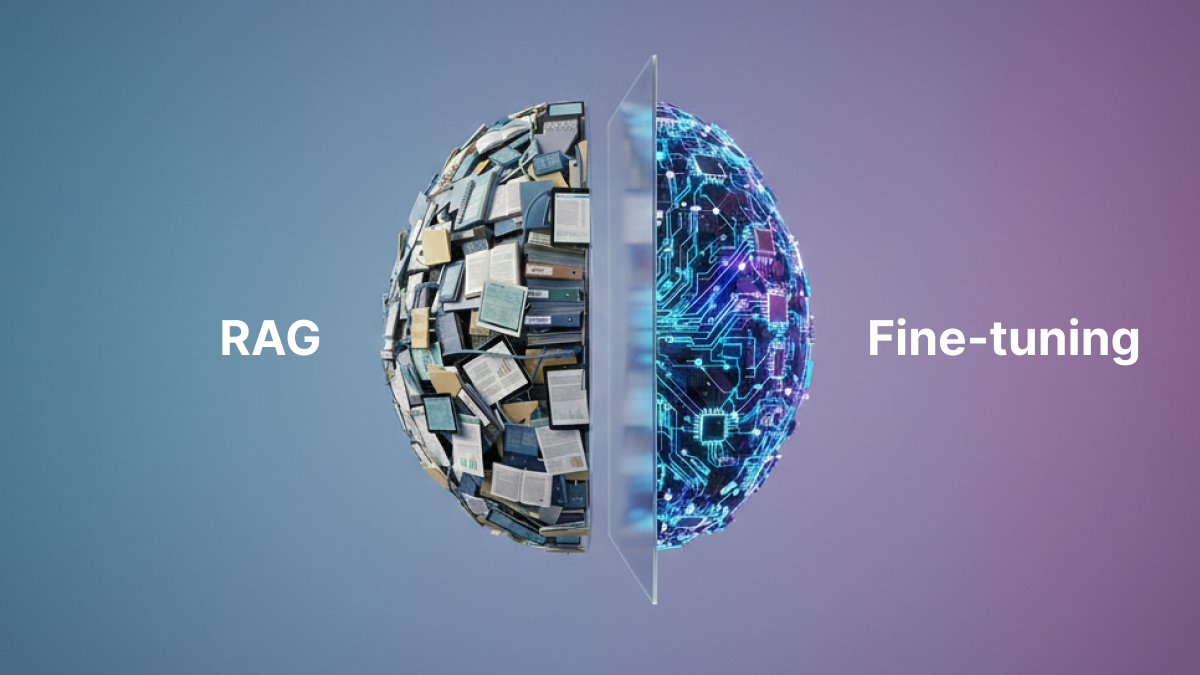
Teams building AI solutions often ask a fundamental question:
"Should we use RAG, or should we fine-tune a model?"
They may seem similar on the surface, but they solve completely different problems. Understanding this difference is the key to building AI systems that are accurate and capable of expert-level reasoning.
Let me start with a real example.
The Estimator Agent Story
We're currently building an estimator agent for a manufacturer in the steel industry.
This company has years of historical quotes and a team of human estimators who make complex decisions based on a mix of:
- engineering drawings
- fabrication steps
- material combinations
- feasibility
- risks
- cost structures
- past experience
Important detail: Their reasoning patterns aren't written anywhere. No document explains how decisions were made. Only the final outcomes exist.
So the question becomes:
Can RAG handle this? No. Because RAG doesn't teach the model how humans think. RAG only helps the model pull supporting information at inference time.
Can fine-tuning handle this? Yes. Because fine-tuning teaches the model patterns, style, and judgement from the company's accepted quotes.
But the best solution isn't choosing one. It's combining both.
What RAG Actually Is (and Isn't)
RAG (Retrieval-Augmented Generation) is an AI pattern where the model retrieves information from an external knowledge base before generating an answer.
It's perfect when you need:
- up-to-date knowledge
- factual grounding
- real-time document lookup
- lower hallucinations
- domain-specific answers without retraining
- dynamic information (SOPs, specs, PDFs, tickets, notes, etc.)
RAG does not teach the model new skills. It simply gives the model relevant context "just in time" so its output is based on the correct documents.
RAG is about knowledge retrieval, not behavior learning.
What Fine-Tuning Actually Does
Fine-tuning teaches a model patterns from your examples.
Use fine-tuning when you want the model to learn:
- reasoning style
- decision-making patterns
- classification logic
- domain-specific judgement
- structured task behavior
- consistency across similar inputs
This is why we fine-tuned the estimator agent using years of accepted quotes. We wanted the model to learn how expert estimators think, not just read documents.
Fine-tuning is about behavior learning, not knowledge retrieval.
Combining the Two
For the estimator agent, we do both:
Fine-tuning Teaches the agent how to reason like an estimator based on historical decisions.
RAG Gives the agent real-time information from:
- BOM lists
- updated PDFs
- new drawings
- client notes
- project constraints
This blend creates an AI system that both understands the context (RAG) and knows how to make decisions (fine-tuning).
Rule of Thumb
If the model needs information → use RAG If the model needs judgment → use fine-tuning If the model needs to perform like an expert using fresh data → use both
That's where the real transformation happens.